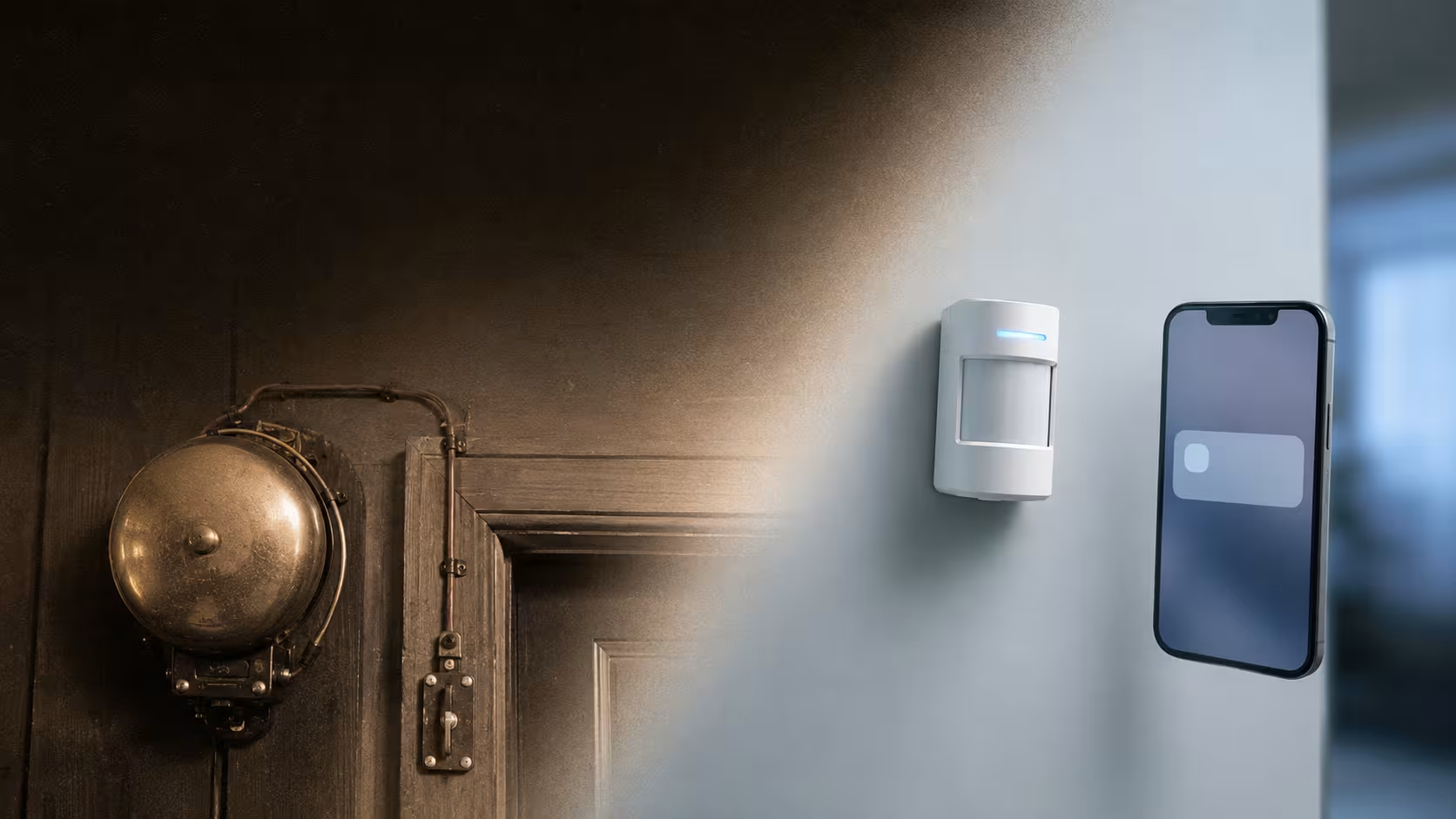
A security alarm is a set of electromechanical and electronic devices that detects anomalous events (an intrusion, an early-stage fire, a personal emergency) and turns that detection into a response: an on-site siren, a push notification, or a call to a monitoring center. Every system, no matter its technological generation, works with the same three-part structure: a sensor that picks up a physical change, a panel that decides whether that change is a real alarm, and an output module that communicates it. The difference between a local alarm (sounds on-site, with no guarantee anyone responds) and a monitored alarm (connected to a Central Monitoring Station that verifies the event and sends help) explains most of the design decisions covered below.
That structure didn’t appear all at once. It was built layer by layer, over 170 years, and each layer solved the problem the previous one left unsolved.
The origins: the first electric anti-theft circuit (1853–1870)
Before electricity, protection relied on mechanical locks and bells. The documented origin of modern electronic security sits in 1853, when Reverend Augustus Russell Pope, of Somerville, Massachusetts, patented the first electromagnetic burglar alarm system (patent US9,802, per the record cited on Wikipedia). There’s a small discrepancy between sources on the exact date (June 21 vs. October 21, 1853); the patent record on Google Patents lists October 21.
Pope’s circuit connected doors and windows in parallel, powered by wet-cell batteries: opening one activated an electromagnet that rang a bell. His most important contribution was a latching switch that kept the alarm ringing even if the intruder closed the door right away (Justice Security).
In 1857, Edwin Holmes bought the rights to that patent for $1,500, founded the Holmes Electric Protective Company in Boston, and moved it to New York in 1859, looking for a city with more crime (Alarmtech). He overcame the public’s initial distrust of electricity with advertising campaigns built on customer testimonials, including one from P. T. Barnum in 1866 describing how the system woke the whole house at any attempt to force a door or window (Frontpoint Security).
Centralized monitoring arrives: ADT and the first stations (1870–1920)
Professional remote monitoring was born tied to the telegraph. In 1874, after a burglary at his own home, Edward A. Calahan connected 50 neighbors to a central office and co-founded the American District Telegraph (ADT) on August 14, 1874, in Baltimore (CanvasBusinessModel). ADT divided cities into districts served by call boxes: pulling a lever sent a telegraph signal identifying the subscriber, and a messenger was dispatched or the police were notified.
In 1877, Edwin Thomas Holmes (Edwin Holmes’s son) discovered he could use Bell’s telephone lines, idle at night, to connect high-value clients like Tiffany to a monitoring center. In 1905, AT&T bought the Holmes Burglar business and folded it into its emergency call systems for police and fire departments (Alarmtech). In 1929, Maurice Coleman founded the Alarm Device Manufacturing Company (ADEMCO) in Brooklyn as a side line of his company Progress Electric Co., and it went on to become one of the most recognized panel and component manufacturers of the 20th century (Security Sales & Integration).
Fire detection becomes formal: ionization and NFPA 72 (1930–1960)
Alongside intrusion detection, fire detection advanced in the late 1930s. Swiss physicist Ernst Meili, building on related observations by Walter Jaeger, developed ionization smoke detection in 1939: an ionized chamber containing a small amount of radioactive material changed its electric current when smoke particles invisible to the naked eye passed through it, triggering the alarm before the fire became visible (Electrical Contractor Magazine).
The National Fire Protection Association, founded in 1896, had already been publishing a sprinkler and alarm code since that year; by the 1940s, that code began covering manual fire alarm systems too (Digitize). As postwar industrial accidents increased, that code evolved into today’s NFPA 72, which sets requirements for supervising initiating device circuits (IDC), notification appliance circuits (NAC), and backup power reliability.
Contacts, foil tape, and panic buttons: the electromechanical era (1950s)
By the mid-20th century, perimeter protection had standardized around three devices:
- Magnetic reed switches: sealed glass tubes with ferromagnetic contacts that change state when a magnet mounted on a door or window moves closer or farther away.
- Foil tape: thin strips of lead or aluminum glued to the edge of large windows; if the glass breaks, the tape tears and interrupts a continuous supervision circuit.
- Panic buttons: buttons hidden under carpets or desks, used to quietly signal a robbery in banks and stores.
Sensors learn to detect without wires: ultrasonic, microwave, and PIR (1950–1980)
Protecting entire interior spaces without wiring every door or window required detection that covered the whole space. In 1953, American inventor Samuel Bagno patented the first motion detector applied to electronic security, sold by Alertronic Corp. (TIME; patent US2,655,645). The sensor filled the room with 19 kHz ultrasound, inaudible to the human ear, and used the Doppler effect: if a body moved, the frequency of the returning echo shifted and triggered the alarm. It set off easily from drafts, vibrations, and even rodents. Microwave detectors came next, using electromagnetic waves instead of sound and able to pass through thin walls.
To solve those false alarms, Herbert L. Berman filed a patent in 1971 for a segmented-mirror optical array for passive infrared (PIR) detection (patent US3,703,718). Unlike earlier sensors, PIR emits nothing: it measures the heat given off by the human body in the far-infrared band, around 9.5 micrometers. In 1979, dual pyroelectric sensors with low-cost Fresnel lenses were sold in large volume, splitting the coverage area into multiple beams and better distinguishing ambient temperature shifts from actual human movement (the exact year of this mass rollout, 1979, is carried over as an approximate reference from the original report).
Panels go digital: Contact ID and automatic dialing (1980–1990)
In the 1980s, relay- and transistor-based logic boards were replaced by microprocessor-driven boards. As the public switched telephone network (PSTN) became universal, automatic telephone dialers appeared. So that panels from different manufacturers could speak the same language to monitoring centers, ADEMCO developed the Ademco Contact ID format, adopted in 1999 by the Security Industry Association under code SIA DC-05 (ANSI Webstore; Security Industry Association).
Contact ID changed how events are reported: it uses DTMF tones instead of the older, slower pulses, sending a 16-digit packet in milliseconds containing this information: account number, message type, whether it’s a new alarm or a restore, event code (110 fire, 130 perimeter burglary, 120 panic), partition number, zone or user, and a final check digit. Around the same time, the SIA Format (SIA DC-03) emerged, using FSK modulation to send readable text with no limit on diagnostic codes.
The data bus and radio frequency replace mass cabling (1990–2000)
Large commercial installations needed more efficient wiring schemes: the old approach, where every sensor carried its own pair of wires back to the panel, gave way to an encrypted data bus on the RS-485 standard, with a single pair of data cables serving hundreds of zones. Canadian company Paradox Security Systems, founded in 1989, introduced the Digiplex series in 1996 with an encrypted digital bus that addressed each device individually (Paradox / asmag.com).
Radio frequency (RF) technology matured in the same decade: panels began including receivers on supervised frequencies (433 and 868 MHz [uncertain]), with a periodic heartbeat signal and low-battery alerts, which made it easier to install alarms in already-finished buildings.
Intrusion, access, and CCTV converge on a single platform (2000–2010)
Systems stopped working in isolation. Alarm panels began integrating access controllers over Wiegand or RS-485 protocols, so arming and disarming synced with proximity-card or fingerprint reads. The alarm signal also began talking to digital video recorders (DVR/NVR) through programmable relay outputs (PGM): when a perimeter zone opened, the PGM would swing PTZ cameras to a preset position and bump up the recording quality to verify the incident on the spot. This relay-based integration is a documented practice in the installation manuals of most DVR/NVR manufacturers from that decade, though no single source is cited here since it’s an industry-wide practice rather than a dated, single-author milestone.
The cloud and cellular replace the phone line (2010–2020)
The gradual shutdown of copper telephony and the arrival of broadband internet forced alarm communication channels to migrate toward IP Ethernet transmitters and cellular modems (GPRS/3G/4G). The Security Industry Association published the SIA DC-09 standard, which sends encrypted packets in Contact ID or SIA structure directly over UDP/IP and TCP/IP with AES encryption (Security Industry Association), eliminating the 20-30 seconds analog dialing used to take and cutting reporting time to under a second.
Network modules like Paradox’s IP150 series kicked off the “Cloud Security” model: processing stopped depending solely on the local panel, and users began arming, disarming, and reviewing event logs from mobile apps connected to cloud servers (like Paradox’s SWAN).
Photo verification, AI, and IoT: today’s standard (2020–present)
Today’s alarms run on fully cloud-based systems with native Internet of Things (IoT) integration. The line between professional electronic security and home automation has nearly disappeared. Manufacturers like Ajax Systems, with their own long-range radio frequency protocols (Jeweller and Wings), don’t need router port forwarding to connect: the equipment talks directly to the manufacturer’s cloud through a proprietary encrypted protocol (Ajax Systems; Ajax Systems — Jeweller).
The most important changes of this stage:
- AI photo verification: PIR sensors with a built-in camera (PIR-Cam) that take a burst of photos when they detect motion and upload them to the cloud within seconds so someone can visually confirm the event.
- Cloud video analytics: deep-learning algorithms that filter out false alarms caused by pets, plants, or lighting changes before dispatching the event to the central station.
- Open IoT standard compatibility: protocols like Z-Wave, Zigbee, or Matter [uncertain], which let a panic alarm trigger automation routines (turning on lights, lowering metal shutters, locking access points).
Relevant brands by era
| Brand | Period of relevance | Specific technological contribution | Presence / impact in Mexico and Latin America |
|---|---|---|---|
| Holmes Electric Protective Co. | 1857 – 1905 | First network of electric alarms with centralized monitoring and nighttime use of telephone lines. | None. Operations limited to the northeastern U.S. |
| ADT (American District Telegraph) | 1874 – present | District-based monitoring via call boxes and later central-station automation. | Very high. Operates monitoring centers in Mexico and Latin America since the late 20th century [uncertain]. |
| ADEMCO (Honeywell / Resideo) | 1929 – present | Standardization of components and invention of the Ademco Contact ID protocol (SIA DC-05). | Dominant. The most-used standard in Mexico between 1980 and 2010 [uncertain]. |
| Alertronic Corp. | 1950s | Sale of the first ultrasonic motion detector (Samuel Bagno). | None to marginal, limited to military or banking installations [uncertain]. |
| DSC (Digital Security Controls) | 1979 [uncertain] – present | First microprocessor-based digital keypads, PowerSeries line [uncertain]. | Widely used by integrators in B2B and residential projects in Mexico since the 1990s [uncertain]. |
| Paradox Security Systems | 1989 – present | Encrypted multiplexed Digiplex bus, Magellan wireless consoles, IP150 module series. | Very high; preferred brand in the mid-market and corporate segment in Mexico. |
| Bosch Security Systems | Mid-20th century [uncertain] – present | Bank-grade intrusion detection, triple logic (PIR/microwave/digital processing) against false alarms. | Focused on the corporate, banking, and critical-infrastructure sector in Latin America [uncertain]. |
| Ajax Systems | 2011 [uncertain] – present | High-efficiency radio frequency (Jeweller/Wings), fast photo verification, native cloud. | Rapidly expanding in the Mexican B2C and B2B market [uncertain]. |
Techno-operational evolution at a glance
| Generation | Approximate period | Technological leap | Enabling technology | Operational impact |
|---|---|---|---|---|
| Gen 1: Early electromechanical | 1853 – 1870s | Shift from mechanical bells to direct-current electric circuits. | Batteries, electromagnets, latching relay. | Uninterrupted local alarm; an intruder can’t shut it off by closing the door. |
| Gen 2: Urban electromechanical central | 1870s – 1930s | Sending events to shared monitoring points. | Dedicated telegraph, nighttime telephone lines, call boxes. | Organized human response emerges via district subscriptions. |
| Gen 3: Volumetric detection and fire safety | 1940s – 1970s | Whole-space detection without physical contact, plus first safety codes. | Ultrasound, segmented PIR mirrors, ionization chambers, NFPA 72 code. | Full interior coverage and early smoke detection before a fire becomes visible. |
| Gen 4: Telephone digitization | 1980s – 1990s | Shift from human operators to digital coding. | Microcontrollers, automatic PSTN dialing, Ademco Contact ID (SIA DC-05). | Millisecond reporting with precise zone and user identification. |
| Gen 5: Data bus and supervised RF | 1990s – 2000s | End of extensive point-to-point cabling. | Multiplexed RS-485 bus, RF transceivers with heartbeat signal. | Lower cabling and labor costs; installation without civil works. |
| Gen 6: IP connectivity and convergence | 2000s – 2010s | Transmission over data networks and subsystem synchronization. | Ethernet/IP, GPRS/3G, SIA DC-09, Wiegand/CCTV integration. | Real-time monitoring and video-based event verification. |
| Gen 7: Cloud, IoT, and AI | 2020s – present | Cloud-native platforms with video analytics and control from any device. | Cloud computing, proprietary RF (Jeweller), PIR-Cam, 4G/LTE/5G networks. | Sharp drop in false alarms thanks to photo verification and self-management. |
Adoption in Mexico and Latin America
Mexico’s formal private electronic security sector gained scale in the late 1970s and early 1980s, with ADEMCO (Honeywell) as the leading brand through direct imports from the United States [uncertain]. In the 1990s, trade liberalization opened the door for DSC and Paradox, which built distribution networks in Mexico City, Monterrey, and Guadalajara [uncertain].
Mexico’s copper telephone network had limited coverage in peripheral industrial areas and was easy to sabotage by cutting lines, which drove early adoption of private VHF/UHF mesh radio and, later, backup cellular transmitters [uncertain]. Today the market splits between app-based self-monitoring (driven by the cost of traditional monitoring centers) and high-end professional monitoring, using multi-brand IP receiving software.
This section draws on the accumulated knowledge of the industry and the institutional memory of pioneer distributors in Mexico, since no published academic historiography yet exists on the early years of private electronic security in the country; for that reason, these dates are presented as reasonable industry approximations rather than facts documented with the same rigor as the rest of the article.
Frequently asked questions
What’s the difference between a local alarm and a monitored alarm? A local alarm only sounds or flashes lights on-site and depends on someone else calling emergency services; a monitored alarm sends the event to a Central Monitoring Station, which verifies it and dispatches help under a professional service agreement.
Who invented the first electronic security alarm? Reverend Augustus Russell Pope, who patented an electric anti-theft circuit with a latching mechanism in 1853. Edwin Holmes bought the patent in 1857 and brought it to market.
What is the Contact ID protocol? It’s the digital communication format (SIA DC-05) developed by ADEMCO that sends alarm events as a 16-digit packet over DTMF tones, identifying account, event type, zone, and user in milliseconds.
What’s the difference between ultrasonic, microwave, and PIR motion sensors? Ultrasonic and microwave sensors are active: they emit energy and measure the returning echo using the Doppler effect. PIR is passive and emits nothing, only detecting body heat, which is why it has fewer false alarms from drafts or vibrations.
Why did alarms move from phone lines to IP and cellular? Because of the gradual shutdown of the copper telephone network (PSTN) and because IP protocols (like SIA DC-09) cut reporting time from 20-30 seconds to under one, on top of no longer depending on a physical line that can be cut.
What is photo verification and why does it matter today? It’s when the PIR sensor itself takes photos upon detecting motion and sends them to the cloud, so an operator or the user can visually confirm whether it’s a real intrusion before dispatching help, which reduces false alarms.
Sources consulted
- Justice Security — A History of Burglar and Security Alarms
- Alarmtech — Inventor of the First Burglar Alarm: Edwin Holmes
- Wikipedia — Edwin Holmes (inventor)
- Google Patents — US9,802 (Pope, 1853)
- CanvasBusinessModel — Brief History of ADT
- Electrical Contractor Magazine — A Brief History of Fire Alarm Equipment
- TIME — Science: Ultrasonic Alarm
- Google Patents — US2,655,645 (Bagno, 1953)
- Google Patents — US3,703,718 (Berman, 1971)
- ANSI Webstore — SIA DC-05-1999 (Ademco Contact ID)
- Security Industry Association — DC-05-2016 (Ademco Contact ID)
- asmag.com — Paradox Security Systems
- Frontpoint Security — The History of Home Security
- Security Sales & Integration — ADEMCO Alarm Security Museum
- Digitize Inc. — History and Future of NFPA 72
- Security Industry Association — DC-09-2026
- Ajax Systems — Hub Jeweller (support)
- Ajax Systems — Jeweller (radio technology)